How to copy like an artist (without stealing anyone's content)
Every good creator copies. Here's how to borrow the structure of posts that work, study outliers instead of big accounts, and turn references into content that's yours.
Every creator you admire learned by copying. The trick is knowing what to take. Copy the structure of a post that works, never its words, footage or story, and you get the lesson without the plagiarism. Here's a practical way to do it for short-form video, carousels and LinkedIn posts.
Copying is how creative work has always been learned
Painters learned by copying masters. Musicians learn other people's songs before they write their own. Austin Kleon made the case in his book Steal Like an Artist: good work comes from collecting influences and remixing them, not from waiting for an idea nobody has had. Social content is no different. The hooks, formats and pacing in your feed were borrowed from somewhere too.
The difference between an artist and a thief is what they take. A thief copies the finished thing. An artist studies how it was made, then makes something else.
Copy the structure, not the surface
When a post works, separate the parts you can learn from and the parts that belong to the creator.
- Take the hook pattern (a contrarian claim, a question, a number), the order of the beats (setup, tension, payoff), the format (talking head, split screen, carousel), the pacing and length, and the kind of proof (a demo, a before and after, a client result).
- Leave their script and captions, their footage and images, their personal story and results, and the visual identity people recognise as theirs, such as fonts, colours and on-screen style.
A useful test: if someone who follows you both would recognise your post as theirs, you copied the surface. If they'd only notice that it's the same kind of post, you copied the structure.
Study outliers, not big accounts
Most people collect inspiration from the biggest accounts in their niche. The trouble is that big numbers mostly tell you an account is big. A creator with five million followers can get hundreds of thousands of views on an ordinary post, so a post with 400K views might be one of their weakest.
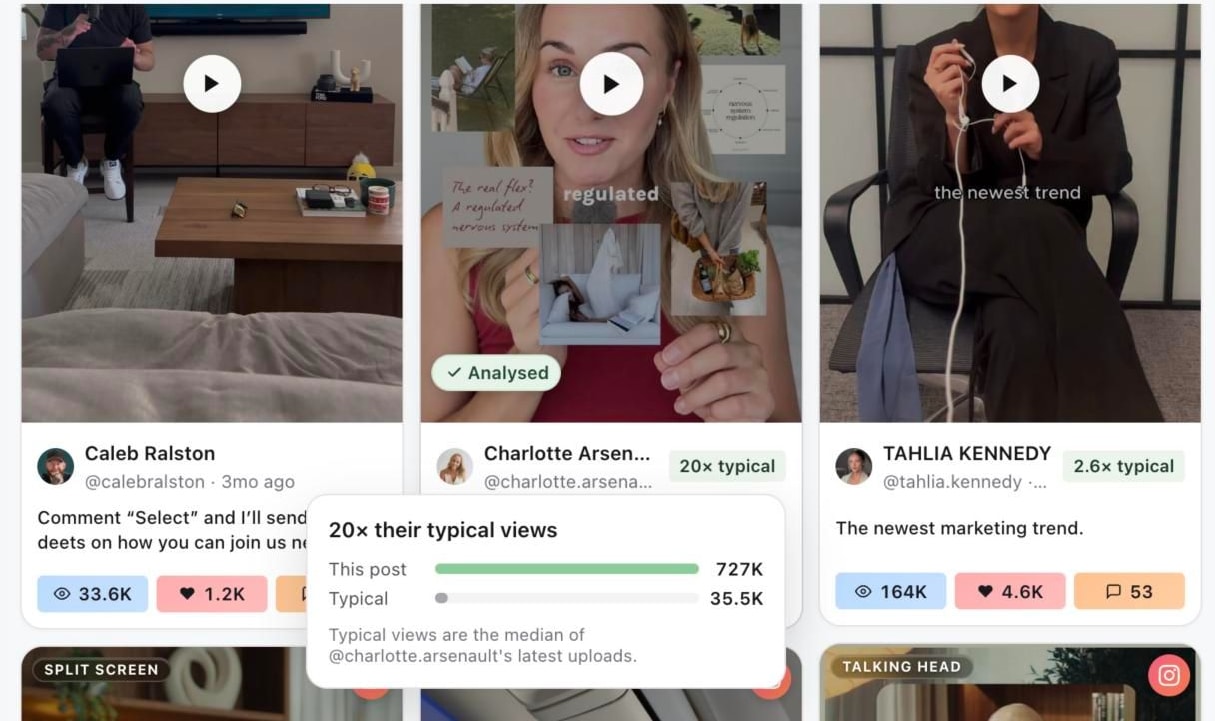
A better signal is how a post did against that creator's normal. If a creator usually gets 35K views and one post gets 700K, something in that post travelled well beyond their audience. That's the post worth studying, whether the account is big or small.
Sequence calls this an outlier score. It compares a post's views with the creator's typical views, the median of their latest uploads, and shows the result on the card, such as 20x typical. In your Inspiration library you can filter to 5x or 10x posts and study only the ones that broke out.
Collect ten references, not one
Copying one post gets you a weaker version of that post. Collecting ten posts that share a pattern shows you the pattern itself, and the pattern is what you can make your own.
Save references in groups as you find them: hooks that stop the scroll, talking-head formats, carousels that teach, founder stories. When it's time to write, open the group instead of relying on memory. In Sequence each group can be a folder in your Inspiration library, and you file a saved post by dragging it onto the folder.
Break a reference down before you make anything
Before you write a word, describe the reference in plain terms. Five questions cover most short-form posts:
- What happens in the first two seconds, and why would someone stop scrolling?
- What's the promise, stated or implied?
- How is the middle built: a list, a story, a demo or a comparison?
- Where's the turn or payoff, and how long does it take to arrive?
- What does the viewer do or feel at the end?
Write the answers as a template, not a transcript. "Contrarian claim, three quick reasons with examples, callback to the claim" is something you can fill with your own expertise. A transcript is something you can only repeat.
Sequence's analysis does this breakdown for posts you save. The transcript, idea, hook and visuals sit in separate tabs, so you can see the structure without rewatching a video ten times.
Change at least two things
Once you have the structure, make it yours by changing at least two of these:
- Format. A talking-head hook can open a carousel, and a carousel's list can become a 30-second video.
- Audience. A pattern that works for fitness coaches can work for accountants, if the problem is real for them.
- Example. Replace their story with yours: your clients, your numbers, your mistakes.
- Angle. Argue the other side of their claim, or go one level deeper than they did.
- Platform. A structure that works on TikTok often lands differently on LinkedIn, so adjust the pacing and the proof.
Two changes are usually enough to make a post clearly yours while keeping what made the original work.
Know where the line is
Some borrowing is part of how platforms work. Trending sounds, formats and memes are made to be reused, and stitches, duets and remixes exist so you can build on someone else's post with credit attached.
Other things aren't yours to take. Don't re-upload someone's video or images, don't read out their script, and don't present their results or story as your own. If your post builds directly on one creator's idea, say so and tag them. It costs nothing, and most creators appreciate it.
A weekly routine that turns references into posts
Copying like an artist works best as a habit, not a scramble before a deadline. A simple week looks like this:
- Monday: review the creators you follow and save the posts that broke out, the ones at 2x or more of their usual.
- Tuesday: file each saved post into a folder and break down two or three of them.
- Wednesday: draft three posts, each changing at least two things from its reference.
- Thursday and Friday: film, design and schedule.
In Sequence, the Watchlist does the Monday work for you. On Pro you can watch up to 15 creators per brand; their new posts arrive in one feed, with an alert when one beats their typical views. From any saved post, Develop into draft creates a new content piece with the reference attached, so the source travels with the idea.
Start with the posts that already worked
Copying isn't the problem. Copying the wrong things is. Take the structure, leave the surface, study outliers, and change enough that the result could only have come from you.
If you want one place to do it, Sequence's Inspiration library keeps your references, folders, outlier scores and creator watchlist next to the content you're planning. Start free.