Content operations vs scheduling: what agencies actually need
Understand where social media scheduling ends, where content operations begins, and which operating model an agency needs as client work grows.
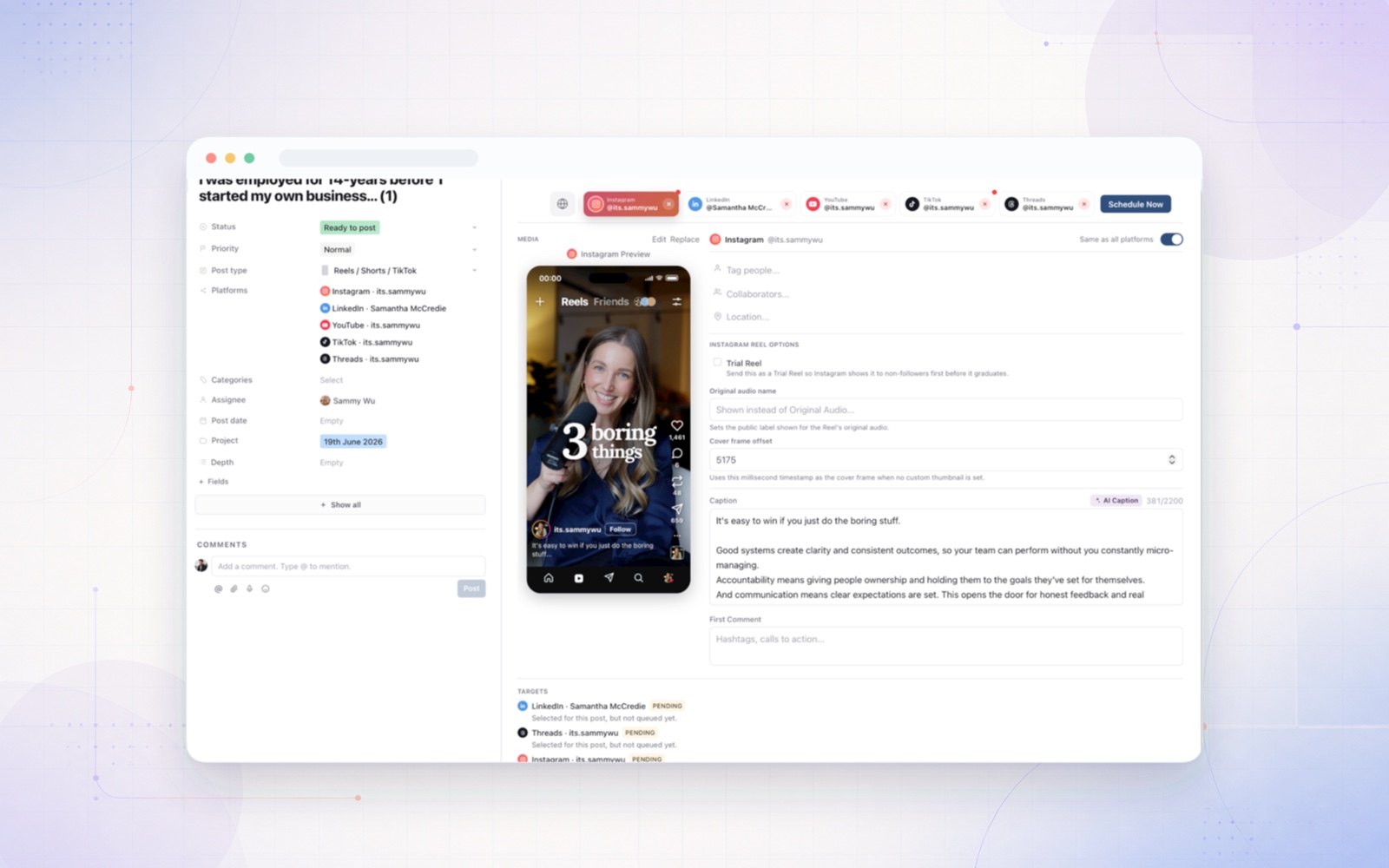
A scheduling tool answers an important question: what should publish, where, and when? For a small team, that may be most of the operational problem. Agencies carry a wider responsibility. They need to turn a brief into a plan, coordinate creative, collect client approval, publish accurately, respond with context, and explain what happened. Scheduling is one step inside that loop. Content operations is the system that keeps the whole loop connected. Knowing the difference helps an agency avoid both extremes: buying too much software too early, or stretching a publishing queue far beyond the job it was designed to do.
What a scheduling tool does
A scheduler is built to queue and publish content. It holds a post, its channel, and its publishing time, then sends it live through a platform connection. Good schedulers reduce repetitive work, make the calendar visible, and help a team maintain a consistent cadence. Those are valuable capabilities, especially when publishing itself is the main source of friction.
Some schedulers add lightweight collaboration, analytics, or an inbox. The distinction is not whether a product has a particular feature. It is what the system treats as the main record. In a scheduling model, the centre of gravity is the publishing queue. Planning and approval tend to happen before content reaches it, while learning and client reporting happen somewhere else after it leaves.
That boundary can be perfectly sensible. Problems begin when an agency expects a queue to hold briefs, versions, decisions, client context, publishing readiness, community conversations, and performance learning without a clear operating model connecting those things.
What content operations means
Content operations is the repeatable loop around the post: plan, review, approve, publish, respond, and learn. The post remains the shared record as it moves through those stages. Its purpose, creative, owner, feedback, approval, schedule, audience response, and results stay connected, so the next decision begins with context instead of reconstruction.
The loop matters because social work does not finish at publishing. Comments can reveal a customer concern. Performance can challenge the original hypothesis. A client may ask why one theme continues while another is dropped. When response and learning feed back into planning, the team improves the system rather than merely filling the next empty calendar slot.
Content operations also makes handoffs explicit. A strategist owns the plan, creative owns production, a client owns approval, and an operator owns publishing. The exact roles vary, but the state of the post shows who needs to act.
When a scheduler is enough
A scheduler is often enough for one brand, a small publishing team, and a straightforward approval path. If the same two people plan, create, approve, and publish, they can carry context in their heads. A simple calendar, a reliable queue, and native platform analytics may give them everything they need without adding another operating layer.
It can also be enough when the agency has deliberately standardised the surrounding work elsewhere. A project system may hold briefs and owners, a documented process may govern approval, and reporting may already be efficient. If those handoffs are reliable, replacing them may create more disruption than value.
Use the smallest system that keeps the work controlled. Signs of a healthy scheduling setup include few missed approvals, little manual status chasing, clear ownership, and reports that do not require days of assembly. If the team can answer where a post stands and why it performed without searching across several tools, the current setup is doing its job.
Where scheduling starts to break
Complexity rises quickly with multiple client brands. Each client has different approvers, access needs, campaign dates, tone rules, and reporting expectations. The agency adds a spreadsheet to see the portfolio, a deck for review, chat for quick feedback, and a reporting tool for results. The scheduler still publishes, but it no longer represents the real state of the operation.
Approval overhead is usually the first visible symptom. Teams export calendars, chase replies, copy comments between systems, and manually check whether the scheduled version matches the approved one. Reporting overhead follows. Metrics are exported and rearranged without the original brief or decision nearby, so the team can describe what happened but struggles to explain what should change next.
Context scattered across tools also creates management risk. Capacity looks fine because the calendar has open slots, while creative is blocked on feedback. An account lead promises a date without seeing an unresolved approval. A new team member can find the file but not the reasoning behind it.
What an operations layer adds
A content operations layer gives the agency a shared view across brands and stages. It connects the brief to the post, the post to its approval, the approval to the schedule, and the published result to the next plan. Clients can participate in the parts they own without entering the agency’s entire internal project system.
Evaluate this layer by the work it removes. Can anyone see which posts are blocked and who owns the next action? Does the approved version flow into publishing without a manual comparison? Can a report lead back to the choices that produced it? Does an insight become a planning input?
Sequence is one such content operations layer, with planning, review, approval, publishing, response, and learning in one shared agency and client workspace. It will not remove the need for clear ownership or good judgement. The value of any layer comes from making those decisions visible, preserving their context, and helping the team run the full loop with less administrative work.